
Most SaaS companies investing in SEO are measuring the wrong things, building the wrong content, and optimizing for outcomes that do not move their business forward. Organic rankings go up. Signups stay flat. The disconnect is not a content quality problem. It is an architectural one.
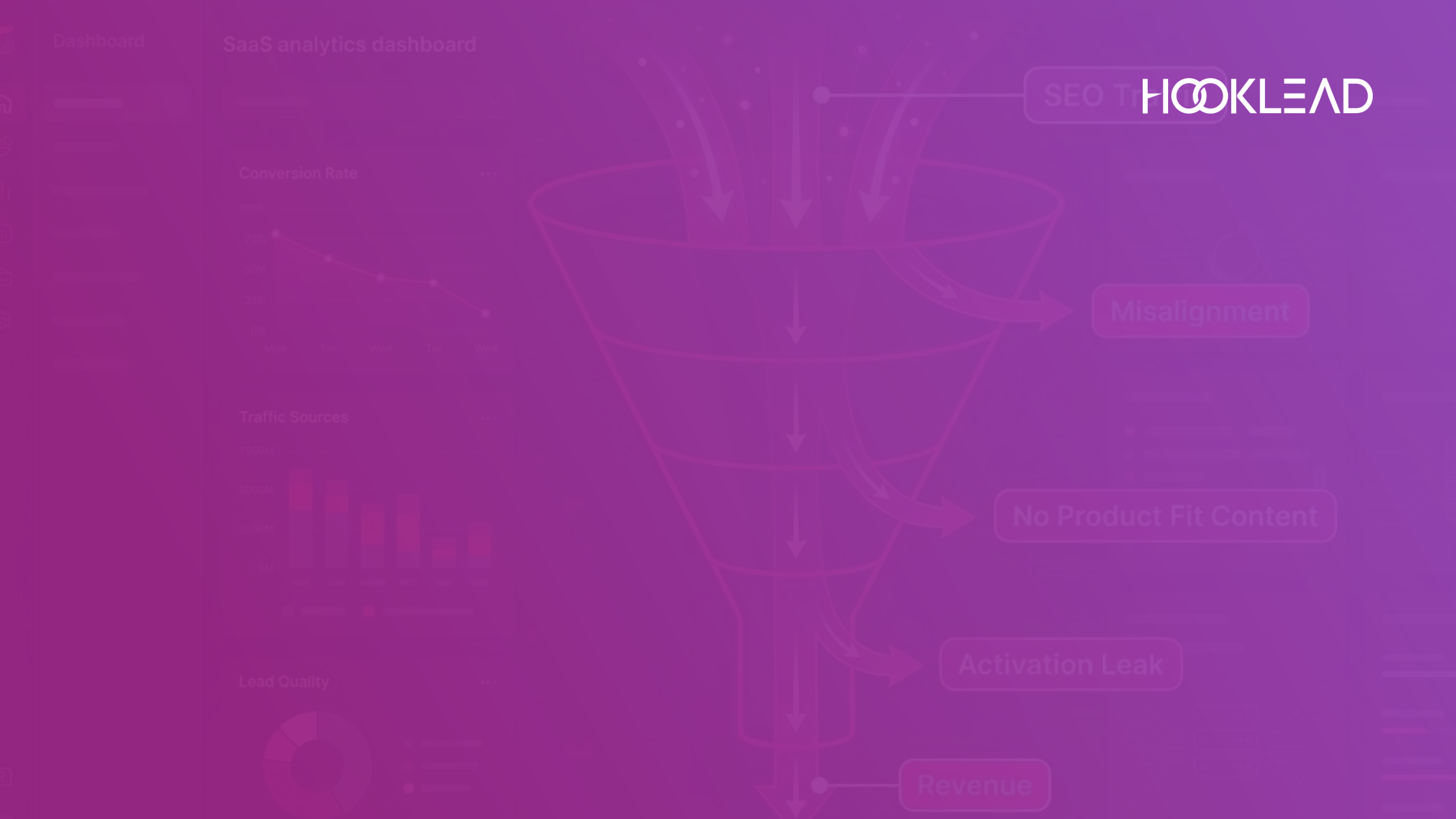
SEO is treated as a standalone acquisition channel when it is actually a system that should connect discovery to evaluation, evaluation to conversion, and conversion to activation. When that system is broken, traffic accumulates at the top of the funnel and leaks out before it ever reaches revenue.
As explained in SEO for SaaS Companies: A Conversion-Focused Playbook for Growth, search visibility should support discovery, evaluation, conversion, and activation, in that order, as one continuous system. The mistakes below describe where that system typically breaks, and why fixing channel-level symptoms without addressing the underlying architecture produces diminishing returns.
Mistake 1: Treating SEO as a Traffic Channel
Traffic volume is not a growth metric. It is a vanity metric with a compelling story attached.
When SaaS teams task SEO with generating traffic, they implicitly accept a disconnect between organic search and revenue outcomes. The SEO team optimizes for clicks. The growth team optimizes for signups and activation. The lifecycle team optimizes for retention. Each function reports into its own dashboard and declares success independently.
The result is a funnel that looks productive in analytics and performs poorly in revenue.
SEO should be scoped and evaluated as a demand generation system, one responsible not just for organic sessions, but for qualified entry points that move toward trial, signup, and product engagement. This means defining SEO success in terms of trial starts from organic, activation rates for organic cohorts, and assisted conversion across the funnel. Tools like GA4, combined with Mixpanel or Amplitude, make this attribution feasible even for early-stage teams.
The organizational question is not how much traffic is SEO generating. It is how much of SEO's contribution is making it through to revenue. When that gap persists and the internal team cannot close it with the resources and strategic context available, SaaS SEO consulting becomes a structural fix rather than an optional resource.
Mistake 2: Publishing Content Without Product Alignment
The most common form of SaaS content waste is high-quality articles ranking for terms that have no relationship to the product being sold.
This happens when content strategy is driven by search volume alone. A SaaS company building B2B project management software publishes guides on general productivity, time management, and remote work culture. Rankings improve. Traffic increases. Conversions stay minimal. The visitors arriving from those articles are not evaluating project management software. They are looking for personal productivity advice.
Product-aligned content connects the search intent behind a keyword to the problem the product solves. It is not a question of stuffing product references into every article. It is a question of whether the audience searching for that term is likely to be in the buyer journey for that category.
Before adding a keyword cluster to a content roadmap, validate three things: whether the intent behind the search aligns with a product use case, whether the reader at that intent stage is a plausible buyer, and whether the content can naturally bridge from the problem being searched to the solution the product provides. Content that cannot pass all three gates is a traffic investment, not a growth investment.
Mistake 3: Ignoring the SaaS Funnel
SaaS has a funnel structure that is structurally different from e-commerce or lead generation. The buying journey includes awareness, category education, vendor evaluation, trial activation, and expansion, each stage with distinct search behavior.
Most SaaS content strategies address the awareness stage adequately and collapse at evaluation. There is content explaining the category. There is almost no content built for the reader who is actively comparing vendors, running trials, or trying to understand whether the product fits their workflow.
Mid-funnel content, including comparison pages, use case breakdowns, integration guides, ROI frameworks, and implementation walkthroughs, is where SEO converts from a traffic generator into a revenue contributor. These are the pages that rank for searches like "[product] vs [competitor]," "[product] for [industry]," or "how to [specific task] with [product type]." They rank with lower volume but meaningfully higher intent.
The strategic error is building SEO entirely around the awareness stage and then wondering why organic traffic does not convert at rates that justify the investment.
Mistake 4: Over-Focusing on Top-of-Funnel Content
Top-of-funnel content has a role. That role is not to drive signups directly. Its purpose is to establish authority, capture early-stage demand, and build the audience that moves down the funnel over time. The problem is when top-of-funnel content becomes the entire strategy.
This creates a content portfolio that is wide in coverage and shallow in conversion impact. Pillar articles and awareness guides attract broad audiences with low specificity. Without mid-funnel and bottom-funnel content to continue those readers' journeys, organic traffic accumulates at the top and disperses.
The fix is not to stop producing top-of-funnel content. It is to build the funnel infrastructure that supports it. Pillar content should link to satellite articles targeting more specific, higher-intent searches. Those satellite articles should link toward evaluation-stage content. Evaluation content should connect to trial start pathways and onboarding resources.
Within a well-structured content cluster, a reader landing on an awareness-level article has a navigable path toward conversion. Without that infrastructure, the pillar article generates sessions that have no place to go.
Mistake 5: Measuring SEO Using Rankings Instead of Growth Metrics
Rank tracking is a useful diagnostic tool. It is not a performance measurement framework.
When ranking position becomes the primary KPI reported to leadership, SEO investment gets evaluated on the wrong outcome. A page can rank in position 3 for a high-volume keyword and drive zero trials. A page ranking in position 8 for a lower-volume, high-intent term may generate consistent signups. The ranking report tells one story. The revenue impact tells another.
The metrics that connect SEO to SaaS growth outcomes include: organic trial starts and demo requests, organic visitor-to-signup conversion rate, activation rate for organic cohorts versus paid cohorts, assisted organic sessions in multi-touch attribution, and organic revenue contribution over rolling periods.
These numbers require connecting Google Search Console data to behavioral analytics (Mixpanel, Amplitude, Heap, PostHog) and CRM attribution. The technical lift is modest. The shift in organizational clarity around what SEO is actually producing is significant.
Until SEO reports on growth metrics rather than channel metrics, it will continue to be evaluated as a cost center rather than a revenue contributor.
Mistake 6: Ignoring AI-Driven Search Discovery
The search environment SaaS companies built their SEO strategies around has changed materially. AI-generated summaries in Google, zero-click answers, and LLM-based research tools are reshaping how buyers discover and evaluate SaaS products in their category.
A buyer researching "best project management software for engineering teams" is increasingly likely to receive a synthesized answer from an AI overview rather than click through a list of ranked results. If the content assets on your site are not structured to be cited and summarized by AI systems, your brand may be invisible in the decision process even when you rank for relevant terms.
Two emerging disciplines address this directly. AEO (Answer Engine Optimization) structures content to be surfaced in AI-generated answers and featured snippets by formatting information in direct, question-and-answer patterns. GEO (Generative Engine Optimization) focuses on building content that LLMs cite when generating research summaries, which requires clear sourcing, structured data, and demonstrated expertise signals.
For SaaS companies, the practical implication is that SEO content must be structured for human readers and AI interpretation simultaneously. Schema markup, clear definitional content, named frameworks, and properly cited claims all contribute to discoverability in AI-mediated search environments.
Ignoring this shift does not immediately collapse an SEO program. It systematically reduces organic share as AI-native search behavior expands within the B2B buyer journey.
Mistake 7: Separating SEO from Onboarding and Activation
This is the mistake with the highest revenue cost, and the one least visible in standard SEO reporting.
When a visitor arrives from an organic search, converts to a trial, and then disengages within the first session without reaching a meaningful product outcome, the cost of that acquisition is absorbed with no return. If organic cohorts have materially lower activation rates than paid or direct cohorts, the problem is not the SEO. It is the disconnect between what SEO content promises and what the onboarding experience delivers.
This is what the HookLead framework identifies as an Activation Leak: the drop-off between signup and meaningful product engagement that suppresses revenue growth. When Activation Leaks are driven by organic traffic, the root cause is often a misalignment between the expectation set by the content a user read before signing up and the onboarding flow they encounter after.
A user arriving from a detailed integration guide expects a structured onboarding path that moves them toward using that integration. If the onboarding flow is generic, delivering the same tour regardless of entry point, that expectation goes unmet and the user disengages.
Correcting this requires SEO and product teams to work with shared activation data. Organic entry-point URLs should be mapped to onboarding flows. Content that drives high traffic but produces low activation should be flagged for onboarding review, not just content revision. Tools like Appcues, Userpilot, and Chameleon support entry-point-aware onboarding that adapts the first-use experience based on acquisition source or referral URL.
SEO and activation are not separate problems. They are two phases of the same user journey. Organizations that treat them as separate functions will continue to generate traffic they cannot convert.
Reconnecting SEO to the Growth Architecture
Each mistake described above has a common origin: SEO is being managed as an isolated channel rather than as a component of the SaaS growth system.
Growth Architecture, as HookLead applies it, treats acquisition, activation, monetization, and retention as interconnected systems. SEO sits inside the acquisition layer, but its performance is shaped by everything downstream. Content that does not align with buyer intent cannot support evaluation. Organic traffic that is not connected to activation data cannot be optimized for revenue. Rankings that are not mapped to funnel outcomes cannot justify investment.
The corrective work is primarily strategic rather than tactical. It begins with defining what SEO is accountable for in revenue terms, then auditing the content portfolio against funnel stage alignment, then connecting organic acquisition data to behavioral analytics and onboarding performance.
The SaaS companies that treat SEO as a growth system component consistently outperform those that treat it as a publishing operation. The difference is not the quality of the content. It is the architecture surrounding it.
To understand how this applies across the full acquisition and conversion funnel, start with SEO for SaaS Companies: A Conversion-Focused Playbook for Growth.
HookLead works with SaaS companies to diagnose full-funnel conversion gaps and build the growth systems to close them. If organic traffic is not converting at the rate your investment warrants, Start the Conversation.