
SaaS pricing examples are most useful when read as GTM artifacts, not price lists. The tier structure, value metric, upgrade trigger, and freemium gate of any SaaS product reveal how that company intends to acquire users, expand revenue within accounts, and retain customers over time. Slack's 90-day message history cap, Notion's AI-bundling decision, and Cursor's credit-based billing model are not isolated pricing choices. Each one encodes a specific growth motion. Pattern recognition across these examples gives founders and growth operators a faster path to a model that fits their own acquisition and retention architecture.
Your Pricing Page Is a Strategic Artifact
Most SaaS pricing decisions get made by looking left and right: at competitors, at what the market seems to accept, at what the sales team says closes deals. The result is pricing that is legible but not intentional. It tells buyers what you charge. It does not tell them, or you, why.
The companies that got this right did so by treating pricing as a growth decision, not a competitive one. Slack built a PLG acquisition engine around a 90-day message history gate. Notion converted its AI pricing into a tier-escalation forcing function. Cursor surfaced what happens when a flat subscription collides with variable infrastructure costs. Each decision reflected a specific growth motion. Each is readable if you know what to look for.
This article decodes three SaaS pricing examples patterns using Slack, Notion, HubSpot, Cursor, OpenAI, and Anthropic as named reference points. Each pattern is grounded in a specific GTM motion. For the conceptual framework behind model selection, including the five-layer pricing architecture that connects model choice to conversion design, the foundation is in our SaaS pricing strategy. What follows applies that lens to real examples.
The goal is not to identify which model is best. The goal is to develop the practitioner's instinct for reading what a pricing structure reveals about the growth motion behind it, and what that means for your own decisions.
Pattern 1: The Viral Seat Model (Slack and Notion Pricing Examples)
The defining characteristic of this pattern is that the freemium tier is not a product sample. It is a pre-sales motion. The free plan exists to seed usage inside a team or organization, create dependency, and then trigger an upgrade event at the moment removing access would cause genuine disruption.
The gate is almost never a feature wall. Feature walls are easy to rationalize around: users find workarounds, they live without the feature, they never hit the ceiling. The gates that actually convert are usage-decay triggers: limits tied to the accumulation of value inside the product over time. Once the product has become the team's institutional memory, the gate becomes unavoidable.
Two companies illustrate this pattern at different stages of their pricing evolution.
Slack
Slack's current pricing structure runs across four tiers: Free, Pro at $8.75 per user per month, Business+ at $18 per user per month, and Enterprise+ at custom pricing through sales. Annual billing reduces both paid tiers: Pro drops to $7.25 per user and Business+ to $15 per user on an annual commitment.
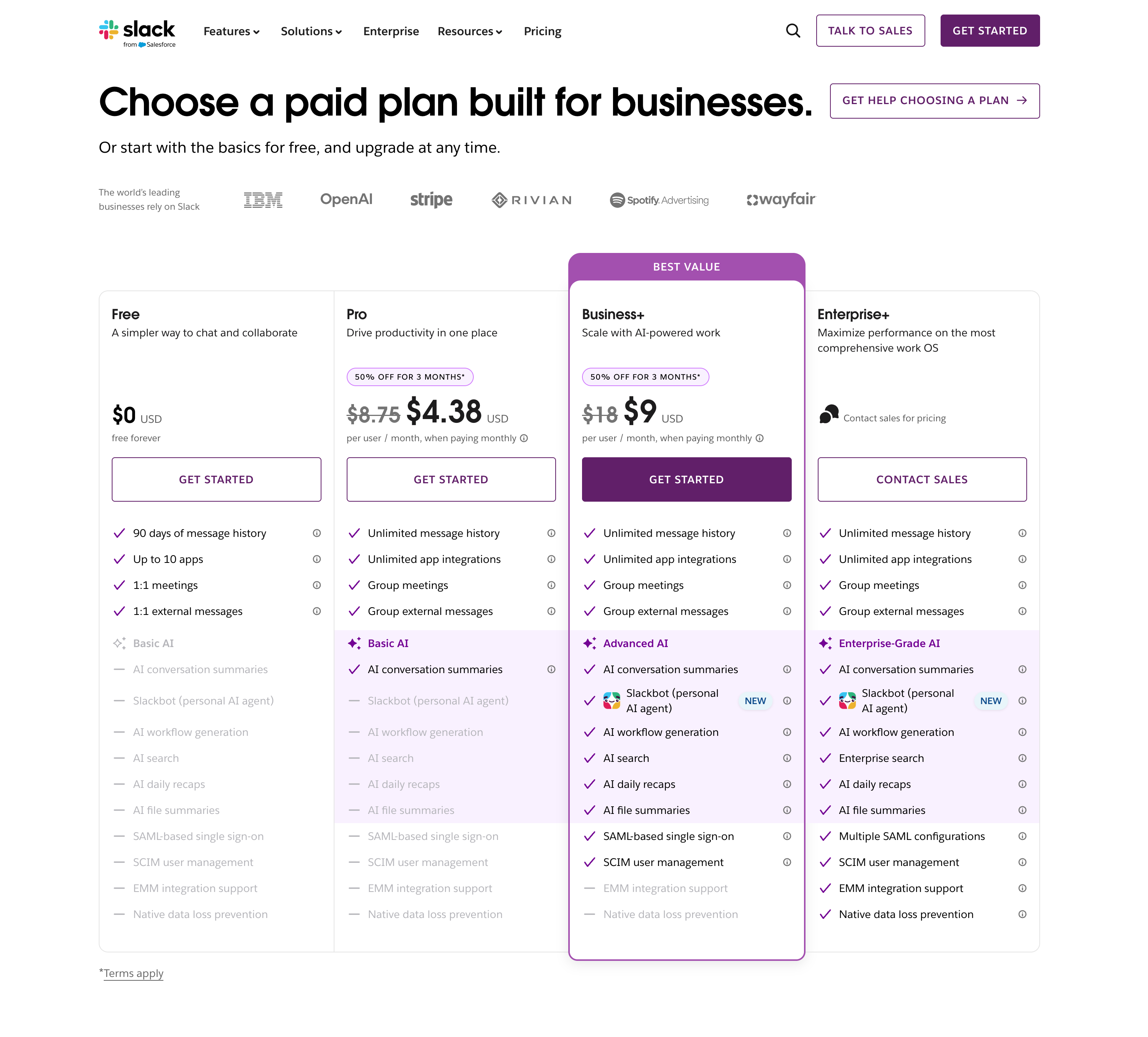
The architecture of the free tier is the key. Slack limits free workspaces to 90 days of searchable message history. It does not remove messages. It makes them invisible. A team on the free plan continues to produce messages, decisions, documentation, and context inside Slack every day. After 90 days, that institutional knowledge disappears from search. The longer a team uses Slack for free, the more painful the gate becomes.
This is a usage-decay trigger, not a feature cap. It fires at the exact moment Slack has become load-bearing infrastructure for team communication. The upgrade from Free to Pro is not driven by wanting a feature. It is driven by not being able to afford losing what is already there.
The August 2025 AI bundling decision reveals the second layer of this architecture. Slack eliminated the standalone Slack AI add-on at $10 per user per month and folded full AI capabilities into Business+. Teams that had been using Slack AI on the Pro tier faced a choice at their next renewal: upgrade to Business+ at $18 per user per month or lose the AI features they had built into their workflows. For teams on annual billing the jump from Pro at $7.25 to Business+ at $15 still represented a meaningful cost increase per seat.
Read as a GTM signal, this is Salesforce executing an enterprise-expansion play on top of a PLG foundation. The freemium layer acquires teams bottom-up. Per-seat billing converts at the team level. Business+ and Enterprise+ extract revenue from the installed base by gating the capabilities that enterprise buyers require: compliance, SSO, AI, and Salesforce CRM integration. The freemium motion and the enterprise motion run in sequence, not in parallel.
Notion
Notion's current pricing structure has four tiers: Free, Plus at $10 per user per month on annual billing, Business at $20 per user per month on annual billing, and Enterprise at custom pricing.
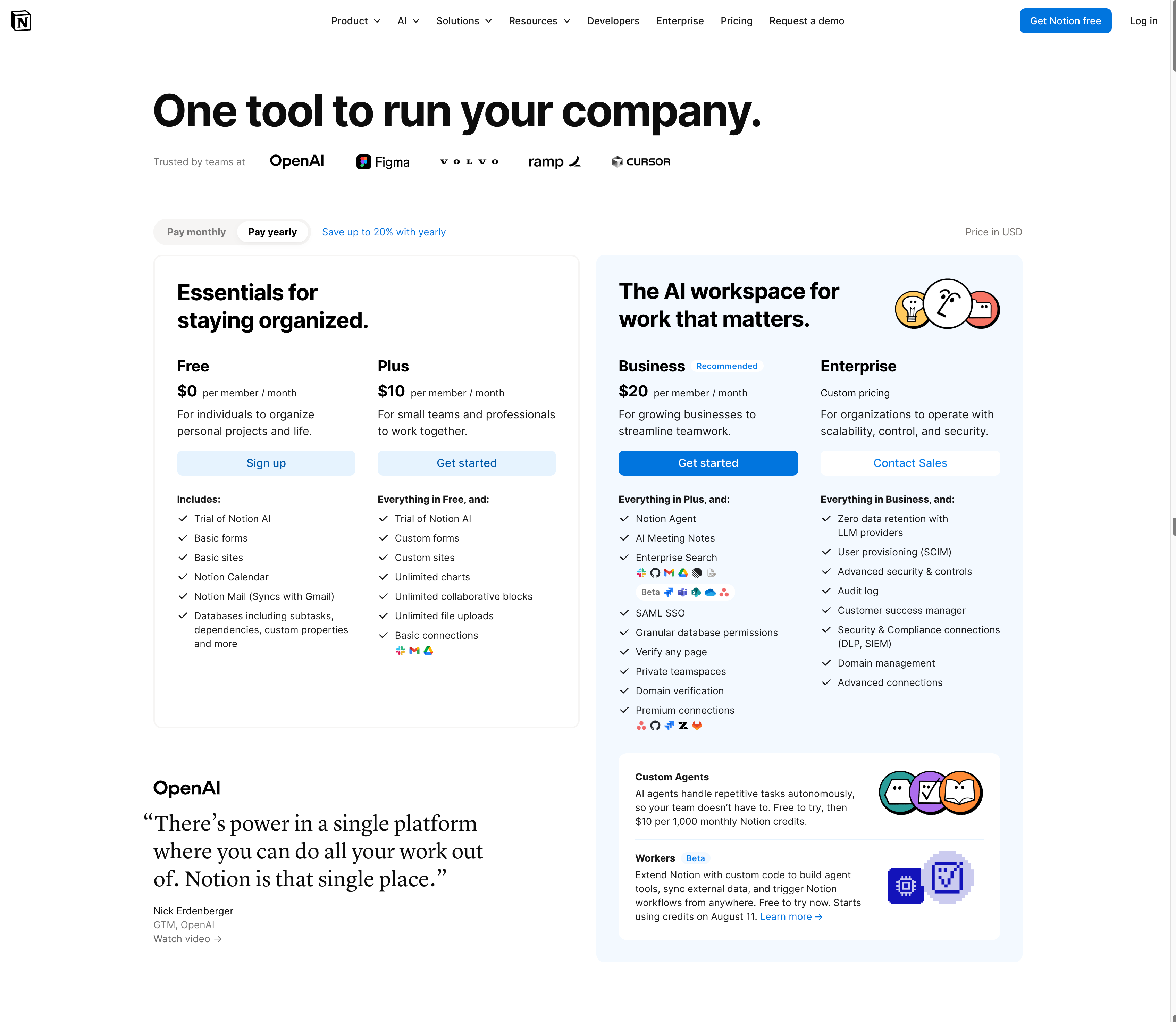
The May 2025 architectural decision is the most instructive pricing move in recent SaaS history for founders considering how to monetize AI features. Notion had launched Notion AI in early 2024 as a standalone add-on at $8 per user per month on annual billing, available on any plan including Free. A team on Plus could add AI for $18 total per user. That structure had a ceiling problem: it gave Notion two revenue streams but no forcing function toward the higher tier.
In May 2025, Notion eliminated the standalone AI add-on for new customers. Full AI, including Notion Agent, AI Meeting Notes, and Enterprise Search, now requires Business at $20 per user. Plus users who had not already purchased the add-on found the option gone. Existing add-on subscribers were grandfathered, but every new account faces a binary choice: Plus without meaningful AI, or Business with the full suite.
This was not a product decision. It was a deliberate architectural choice to use AI as a tier-escalation forcing function rather than a horizontal upsell. The arithmetic pointed in one direction: a $18 blended price of Plus plus the AI add-on sitting within two dollars of the $20 Business tier gave buyers little reason to upgrade. Bundling AI exclusively into Business removed that arbitrage and made the tier decision binary.
The credit layer appearing in mid-2026 on top of the seat tiers signals the next phase of this architecture. Custom Agents and Workers now consume Notion credits at $10 per 1,000 credits per month. Seat pricing captures the collaboration value. Credit consumption will capture the agentic workload value. Notion is building toward the same hybrid structure that HubSpot assembled over the same two-year period.
What Notion and Slack share is the same underlying logic: freemium exists to build dependency, seat pricing converts that dependency into recurring revenue, and tier escalation extracts value from users who have committed deeply enough that changing tools is more expensive than upgrading.
Pattern 2: The Consumption Expansion Model (OpenAI and Anthropic Pricing Examples)
The viral seat model relies on collaboration friction and organizational switching costs to drive expansion. The consumption model does something structurally different: it removes the ceiling on revenue per customer entirely and replaces it with a direct connection between customer value realization and spend.
When a consumption model works, expansion happens inside the product without a sales conversation. There is no renewal negotiation, no upsell motion, no seat-count argument. The customer's spend grows because their usage grows because their outcomes grow. That alignment between value and revenue is the mechanism behind the elite NRR numbers that consumption-based companies produce. Snowflake reported 158% net revenue retention in Q4 FY2023, per their SEC Form 8-K filed March 1, 2023, the highest sustained NRR ever reported by a public cloud company at meaningful scale, sustained at 125% through Q4 FY2026 per their February 2026 SEC filing.
When it does not work, the same alignment becomes a liability. If customers optimize their usage, revenue contracts automatically. There is no seat floor, no minimum commitment, no churn event that triggers a retention conversation. The model gives and takes with equal efficiency. Snowflake experienced this directly in 2023 when cost-conscious enterprises cut compute spend and NRR began a multi-quarter decline from its peak.
The prerequisite for consumption pricing is an unambiguous value metric: one that maps directly to a quantifiable customer behavior that scales with the customer's business. Without that mapping, consumption pricing produces revenue volatility without the expansion upside. That prerequisite, not the model itself, is what the Snowflake benchmark actually demonstrates.
OpenAI and Anthropic: the consumer/developer split
The AI model providers have introduced a pricing architecture that does not map cleanly onto either the seat model or the classic consumption model. Both OpenAI and Anthropic run two structurally distinct businesses on a single platform: a consumer subscription product for human-paced work, and a pure consumption API for developer workloads.
The split is intentional and architecturally significant. Consumer subscriptions, including ChatGPT Plus at $20 per month and Claude Pro at $20 per month, offer flat-rate predictability for users who interact with the product at human speed. The monthly usage of a typical consumer is bounded by available hours. Flat pricing fits that behavior.
API pricing runs on a completely different value metric: tokens consumed. Developers building applications on top of these models can drive millions of tokens in a single session. Flat pricing for API access would either leave substantial revenue uncaptured for high-volume builders or price out low-volume ones entirely. Pure consumption at the per-token level captures both ends of the demand curve.
Anthropic's model-tier architecture adds a third layer of sophistication. The three named model families, Haiku, Sonnet, and Opus, are not just capability tiers. They are consumption segmentation tools. The model selection decision becomes the primary cost lever for every developer building on the API. A high-volume, lower-complexity workload routes to Haiku. A reasoning-intensive, lower-volume workload routes to Opus. The pricing architecture itself teaches developers how to use the product efficiently.
What AI-native pricing demonstrates for the broader SaaS market is that the consumer subscription model and the developer consumption model can coexist inside a single product without cannibalizing each other, provided the value metrics for each buyer type are genuinely different. The failure mode is applying a single metric to buyers whose usage patterns have nothing in common.
Pattern 3: The Compute Pass-Through Hybrid (Cursor Pricing Example)
The third pattern is the newest and the most structurally unstable. It emerged specifically because AI coding tools and workflow products sit between end users and third-party model providers. These products discovered, often painfully, that flat subscription pricing is a subsidy when the cost of goods sold is a metered API.
Cursor
Cursor's current pricing runs four tiers: Hobby at no cost, Individual at $16 per user per month on annual billing or $20 per month on monthly billing, Teams at $32 per user per month on annual billing or $40 per month, and Enterprise at custom pricing.
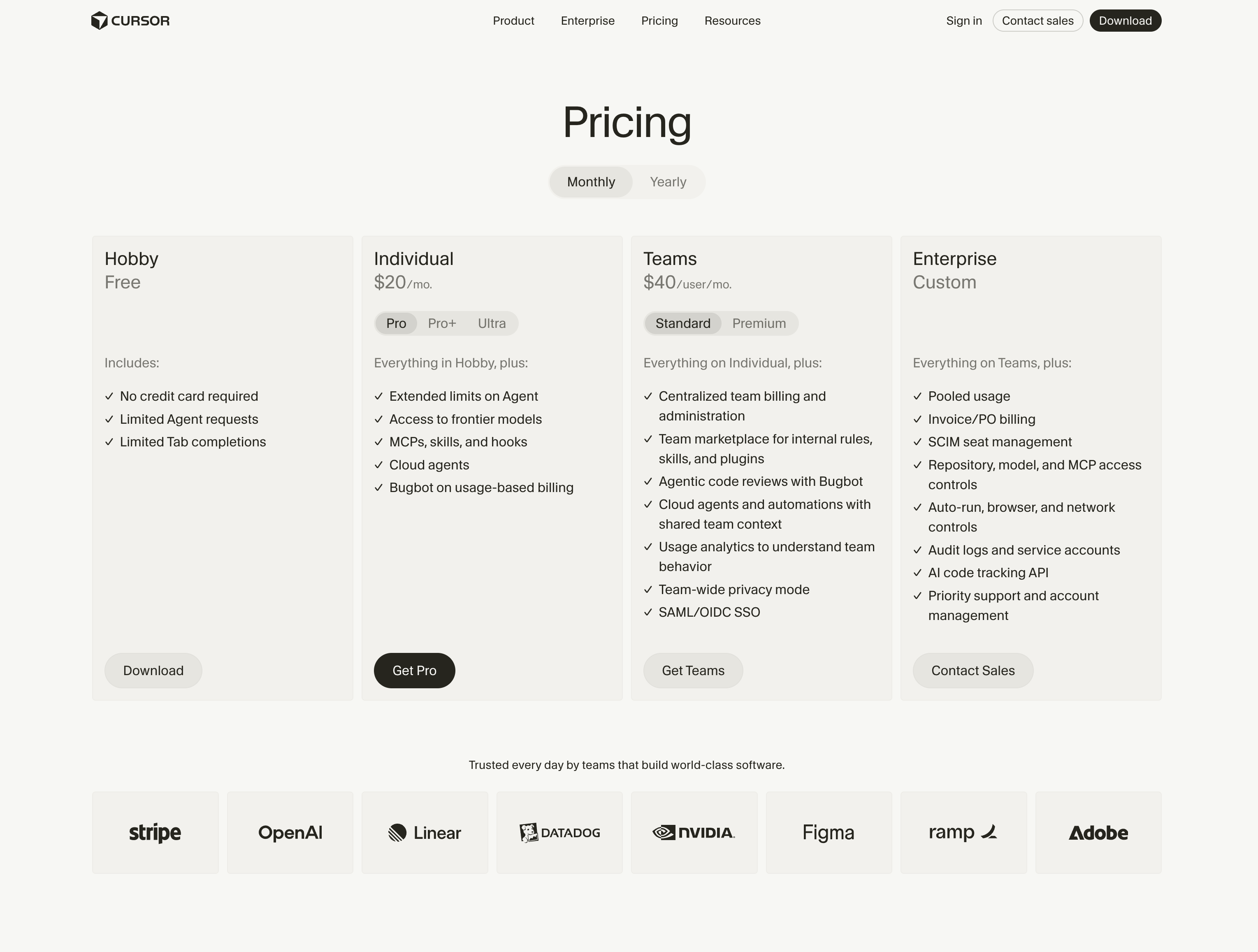
The Individual plan includes a credit pool equal to the monthly subscription price. Auto mode, Cursor's routing system that selects the most appropriate model for a given task, is unlimited. Manually selecting a frontier model draws from the credit pool at rates that mirror the underlying API costs from Anthropic, OpenAI, and Google. When the credit pool is exhausted, usage continues at pay-as-you-go rates unless the user has disabled overages in their account settings.
This structure is the result of a forced correction, not a design choice. Before June 16, 2025, Cursor's Pro plan offered 500 premium requests per month at a fixed price. That model assumed predictable per-request costs from the underlying model providers. When those costs increased as API token prices from Anthropic and OpenAI roughly doubled and quadrupled in the preceding 12 months, the fixed-request model became structurally untenable. Cursor was absorbing the spread between what it charged users and what it paid providers.
On June 16, 2025, Cursor moved to credit-based billing. The transition was communicated poorly. Users who had been operating under the assumption that 500 requests meant a knowable monthly cost encountered surprise overage charges. Cursor issued a public apology and provided full refunds for unexpected charges between June 16 and July 4, 2025.
The architectural lesson is not specific to Cursor. GitHub Copilot introduced premium-request metering on top of its seat-based plans two days later, on June 18, 2025. GitHub subsequently announced that all Copilot plans would transition to usage-based AI Credits billing effective June 1, 2026. Agentic usage patterns had made the fixed-request model unsustainable because the company was absorbing escalating inference costs behind the scenes.
Two companies, the same structural problem, surfacing within 48 hours. When the cost of goods sold is a third-party metered service, the pricing architecture must mirror that meter or the product is running a subsidy. The credit-based hybrid introduces budget anxiety and usage friction that flat pricing was designed to eliminate. But it is the honest architecture for a product whose underlying costs are variable and controlled by someone else.
The Companies That Changed Their Architecture Mid-Flight
Pattern recognition from static examples has limits. The more instructive signal comes from watching companies change their pricing architecture after launch: the decisions they make when the original structure stops serving the growth motion.
HubSpot: building a four-axis expansion engine
HubSpot's pricing does not live on a single page. Each product has its own pricing structure: Marketing Hub, Sales Hub, Service Hub, Content Hub, Data Hub, and Commerce Hub each carry their own Free, Starter, Professional, and Enterprise tiers with independent price points. Marketing Hub Professional starts at $800 per month and includes 3 Core Seats, with additional Core Seats at $45 per month. Sales Hub Professional starts at $90 per seat per month. The bundle configurator at hubspot.com/pricing/bundle lets buyers mix and match Hubs and tiers, producing a total that can range from $7 per month at a single-Hub Starter configuration to over $1,400 per month at a multi-Hub Professional build.
Layered on top of Hub tier and seat count is a third dimension: HubSpot Credits. Credits are consumed by AI agents at defined rates: Customer Agent at 50 credits per conversation resolved, Prospecting Agent at 100 credits per recommended outreach, Data Agent at 10 credits per smart properties run, and Workflow AI actions at 10 credits per execution. Credits are priced at $9 per 1,000, with Starter plans including 500 credits per month and Professional plans including 5,000 per month. Teams that exhaust their included credits purchase additional pools.
The result is a structure with four genuinely independent expansion paths inside a single account: add seats within a Hub, upgrade a Hub tier, add a new Hub entirely, or increase AI credit consumption. Each axis has its own trigger and its own ceiling. A customer who has maximized seat count on Sales Hub can still expand by upgrading Marketing Hub to Professional, adding Service Hub, or increasing credit volume for AI agents. The sales motion meets the customer wherever they are on the expansion curve, without requiring a net-new sale to grow revenue.
This is a deliberate design choice, not an accumulation of product additions. The architecture means HubSpot's revenue per account is not dependent on any single expansion vector. It compounds across all four simultaneously inside the same account.
The AI credit pendulum
HubSpot's credit introduction was part of a broader industry shift. At the end of 2024, 35 companies in the PricingSaaS 500 Index offered credit-based pricing. By the end of 2025, that number had risen to 79, a 126% increase in 12 months, per Kyle Poyar and Rob Litterst writing in Growth Unhinged in January 2026. Among the companies adding credit models in 2025: Figma, HubSpot, Salesforce, Notion for agentic workflows, Cursor, and GitHub Copilot.
The same period produced a counter-current. Jasper eliminated credit limits entirely in May 2023, moving to unlimited word generation on paid plans. Their stated reason: credits caused confusion in the purchase process and reduced usage. Anthropic's consumer tiers, Pro at $20 and Max at $100 and $200, are built as clean flat-rate subscriptions with no credit abstraction for human-paced work, even as the API runs pure consumption.
The architecture question is not whether credits are the right model. It is whether the value metric your pricing captures matches what your customers actually do with your product. Credits work when customers are buying compute capacity for variable agentic workloads. They produce friction when customers are buying access to a tool they intend to use at human pace. The companies getting this wrong are the ones applying a cost-pass-through structure to a product whose buyers expect flat predictability.
The Three Patterns Side by Side
The table below maps each SaaS pricing pattern to the GTM motion it serves, the value metric it captures, how the upgrade trigger works, and which companies have built their structure around it. The patterns are not mutually exclusive. HubSpot runs elements of all three simultaneously. Most SaaS products will find one pattern as their primary architecture and borrow selectively from the others.
The column that matters most for founders making a first-principles decision is the value metric. That is the variable the pricing structure must capture. Everything else, the gate mechanic, the tier design, the credit layer, follows from getting that one thing right.
What You Can and Cannot Borrow from These SaaS Pricing Examples
The examples above are useful for pattern recognition. They are not useful as direct templates. The three most common mistakes founders make when benchmarking pricing against companies like these:
Freemium requires a usage-decay trigger, not just a feature gate
Slack's freemium architecture works because team communication software accumulates institutional value over time. Every message, decision, and document that passes through Slack makes the eventual gate more painful. If your product is used by a single person for a bounded task, a one-time report, a single project, an occasional analysis, the usage-decay trigger has nothing to accumulate against. The gate fires, and the user stops using the product rather than upgrading. Freemium is a pre-sales motion only when the product creates compounding dependency.
Consumption pricing requires an unambiguous value metric
The NRR performance of consumption-based companies is a consequence of direct mapping between the value metric and a quantifiable customer behavior that scales with business growth. That alignment does not exist in most SaaS products. If the behavior you are metering is not directly tied to an outcome the customer is actively trying to scale, consumption pricing produces revenue volatility without the expansion upside. The benchmark applies only when your value metric has the same properties as the benchmark company's.
Credit-based billing solves a vendor cost problem, not a buyer value problem
Cursor's credit model exists because Cursor's cost of goods sold is variable and controlled by third parties. The credit layer passes that variability to the user. From the user's perspective, credits introduce budget anxiety and usage friction that flat pricing eliminates. The 126% growth in credit-based pricing adoption reflects vendor economics, not buyer preference. If the COGS is not a third-party metered service, the credit abstraction adds complexity without structural justification.
Three questions worth answering before selecting a model:
- What is the single behavior that most directly correlates with value delivered in your product?
- Does your acquisition motion require a freemium gate with compounding dependency, or a trial with a hard conversion event?
- If you priced on consumption tomorrow, would your cost structure support it, or would you be subsidizing heavy users while light users subsidize nothing?
The pattern is only useful if it surfaces the right question for your specific product and motion. Notion's May 2025 AI bundling decision was the right call for Notion's tier structure and ICP. It would be the wrong call for a product whose lower tier is doing the majority of revenue work. Reading pricing as a GTM artifact is the discipline. Applying someone else's architecture without that diagnostic step is how pricing decisions get made by looking left and right instead of inward.
Frequently Asked Questions About SaaS Pricing Examples
What are the most common SaaS pricing models with examples?
The four most common SaaS pricing models are per-seat subscription, usage-based consumption, tiered feature gating, and hybrid combinations. Per-seat models such as Slack and Notion tie revenue to headcount. Consumption models tie revenue to a quantifiable usage metric. Tiered models gate features behind price points. Hybrid models layer a consumption or credit component on top of a seat base, which is the direction most AI-adjacent SaaS products have been moving.
The model that produces the strongest NRR is typically the one whose value metric most directly mirrors customer outcomes. The Benchmarkit and Maxio 2025 SaaS Pricing Trends Report, covering 316 companies, found hybrid models reporting the highest median revenue growth rate at 21%, outperforming both pure subscription and pure usage-based structures. Neither benchmark applies universally. The relevant question is whether your value metric behaves the same way as the benchmark company's, not whether you can apply the same structure.
What is the difference between per-seat and usage-based pricing?
Per-seat pricing charges a fixed amount per user regardless of how much each user does with the product. Usage-based pricing charges based on a measurable unit of consumption such as API calls, compute credits, data volume, or completed tasks. Per-seat models cap revenue expansion at headcount. Usage-based models have no ceiling: expansion happens automatically as customer activity grows, without a sales conversation or renewal negotiation.
The trade-off is predictability versus alignment. Per-seat pricing gives both vendor and customer a predictable monthly number. Usage-based pricing aligns vendor revenue with customer value realization but introduces volatility in both directions. When customers grow, revenue grows automatically. When customers optimize usage or reduce activity, revenue contracts just as automatically. The right model depends on whether your value metric is bounded by headcount or scales with customer behavior independent of seat count.
How do I choose a SaaS pricing model for my product?
Start by identifying the single behavior in your product that most directly correlates with the value a customer receives. If that behavior scales with headcount, per-seat pricing captures it cleanly. If it scales with usage volume independent of headcount, consumption or hybrid pricing is more accurate. If neither applies cleanly, tiered feature gating works best when the tiers map to distinct buyer segments with genuinely different willingness to pay.
The second consideration is your acquisition motion. Freemium requires a product that creates compounding dependency over time. A product used for bounded, occasional tasks does not create that dependency, and a freemium gate will produce low conversion rather than upgrade pressure. A free trial with a defined conversion event is more appropriate when the product's value is demonstrable within a fixed window. The model that fits your acquisition motion is not always the model that maximizes long-run NRR, and those trade-offs are worth mapping explicitly before committing to a structure.
What is a good freemium conversion rate for SaaS?
Benchmarks from Lenny Rachitsky and OpenView Partners put freemium self-serve conversion at 2 to 5% as a functional range and 6 to 8% as strong performance. Sales-assisted freemium conversion benchmarks at 5 to 7% functional and 10 to 15% strong. Free trial conversion rates are substantially higher: opt-in trials without a credit card typically convert at 15 to 25% for top performers.
These benchmarks vary significantly by segment and ACV. B2B SaaS targeting enterprise accounts with ACV above $10,000 typically converts trials at 12 to 18%. Developer tools convert freemium users at 1 to 3% because the buyer and budget holder are often different people. Productivity software sits at 3 to 7%. The conversion rate is a consequence of architectural design, not just traffic volume. A freemium gate engineered for compounding dependency will convert at rates that bear no resemblance to the aggregate benchmark.
How do AI companies price their products differently from traditional SaaS?
AI-native companies typically run two parallel pricing architectures. Consumer-facing subscriptions use flat monthly pricing because human-paced usage is bounded and predictable. Developer-facing API access uses pure consumption pricing on a per-token basis because programmatic usage is unbounded and scales with the application being built. A single pricing model cannot serve both buyer types without either leaving revenue uncaptured or pricing out one segment entirely.
The second structural difference is variable cost of goods sold tied to inference compute. Traditional SaaS COGS is largely fixed once infrastructure is built. An AI product's marginal cost per query changes as model providers reprice their APIs. This cost structure has pushed AI-adjacent tools toward credit-based hybrid models that pass compute variability to the customer. Per Kyle Poyar and Rob Litterst's January 2026 Growth Unhinged analysis, 79 companies offered credit-based pricing by end of 2025, up from 35 at end of 2024. Whether that direction holds depends on whether customer tolerance for budget unpredictability persists as credit models become the norm.
Pricing as a Diagnostic, Not a Template
The companies in this article did not arrive at their pricing structures by benchmarking each other. Slack's 90-day gate is a product of how collaboration software creates value over time. Notion's May 2025 bundling decision came from a specific tier-revenue problem. Cursor's credit model came from an infrastructure cost structure that left no cleaner option. Each architecture reflects the specific intersection of product, motion, and economics that company was navigating at that moment.
That context is what makes pattern recognition useful and direct imitation dangerous. The patterns tell you what to look for in your own product. The gate mechanic that works for Slack requires compounding dependency. The consumption NRR benchmarks require an unambiguous value metric. The credit layer Cursor is running requires a cost structure that justifies the user friction.
If your growth has stalled and the pricing architecture question feels unresolved, the diagnostic starts with the value metric: what your customers are actually paying for. That work is worth doing with someone who has seen both sides of the equation.
If you want to work through what the right structure looks like for your specific product and motion, that is the kind of conversation we run through HookOps. Start there.